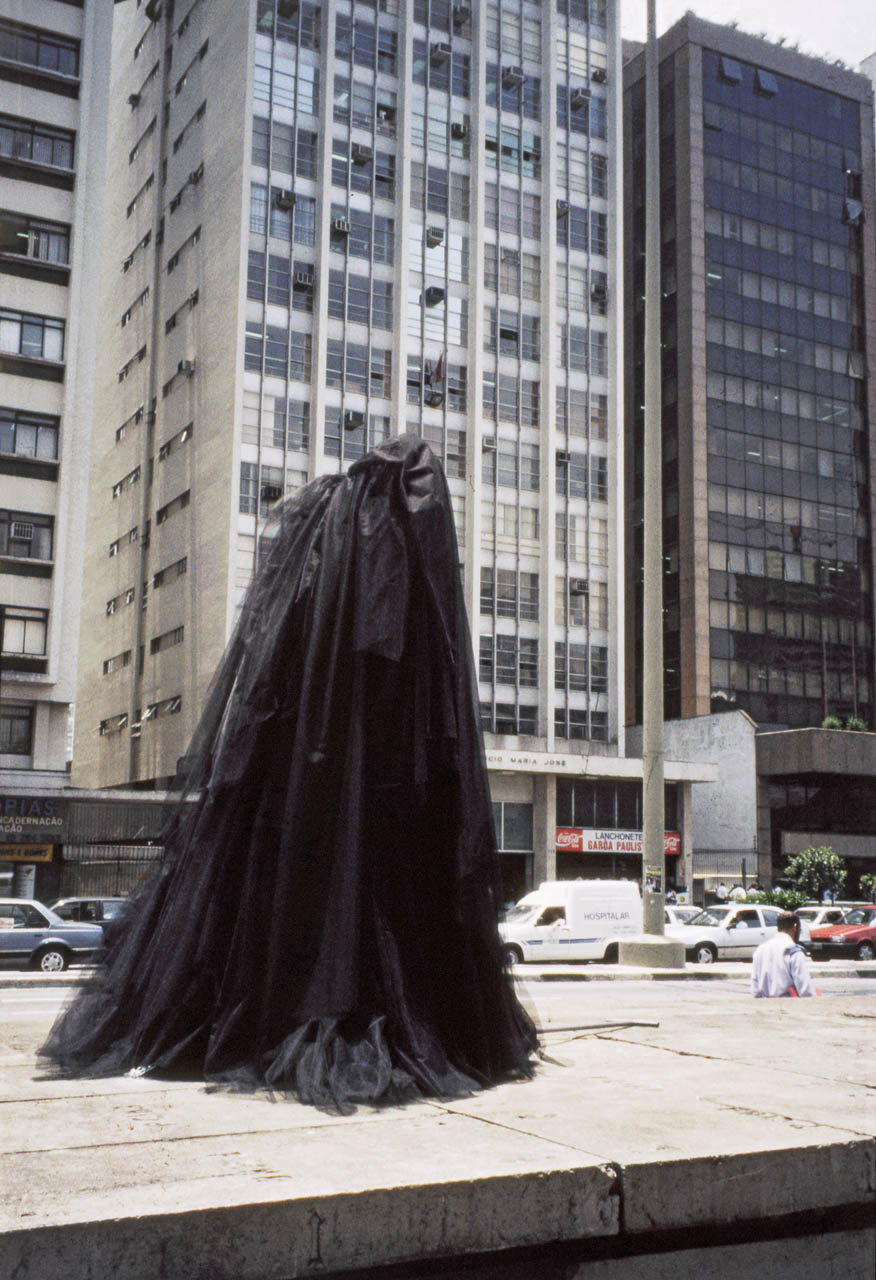
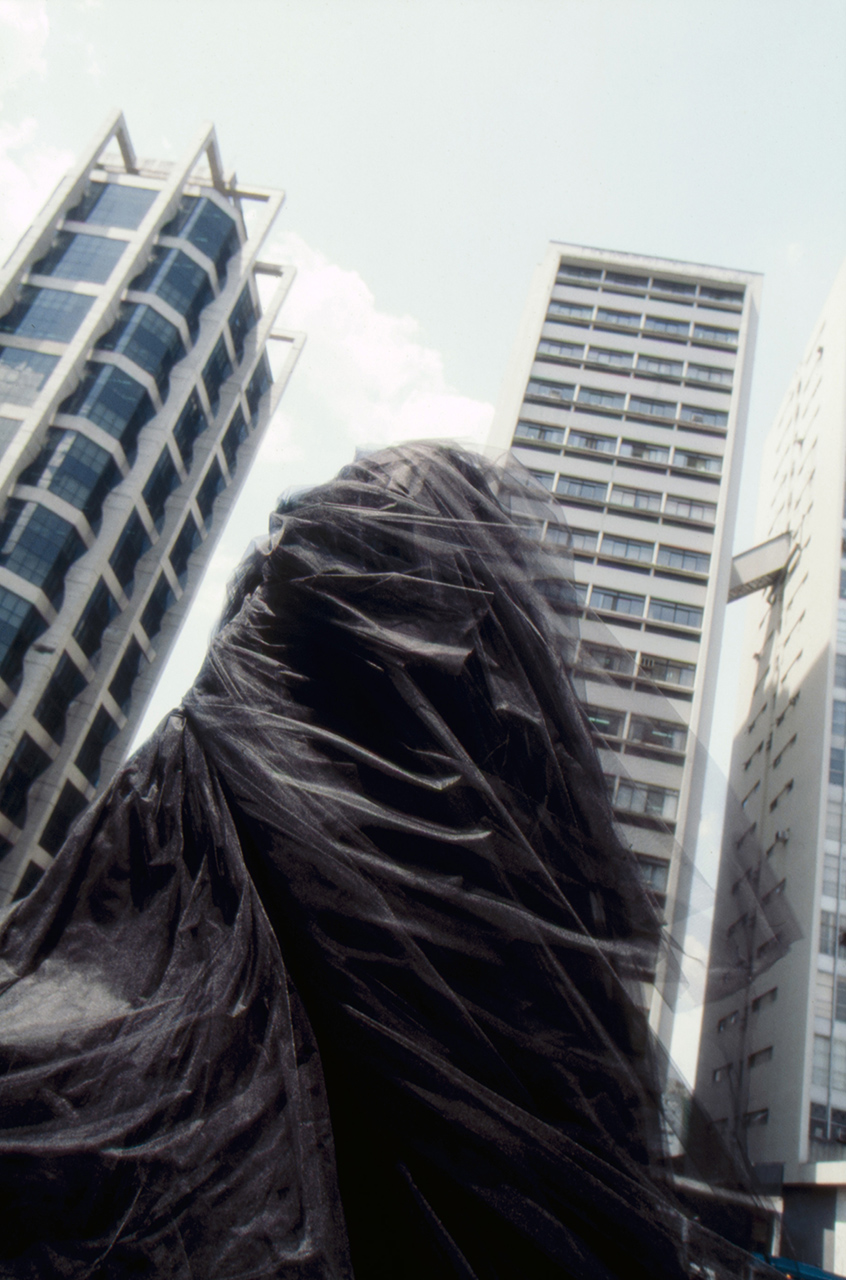
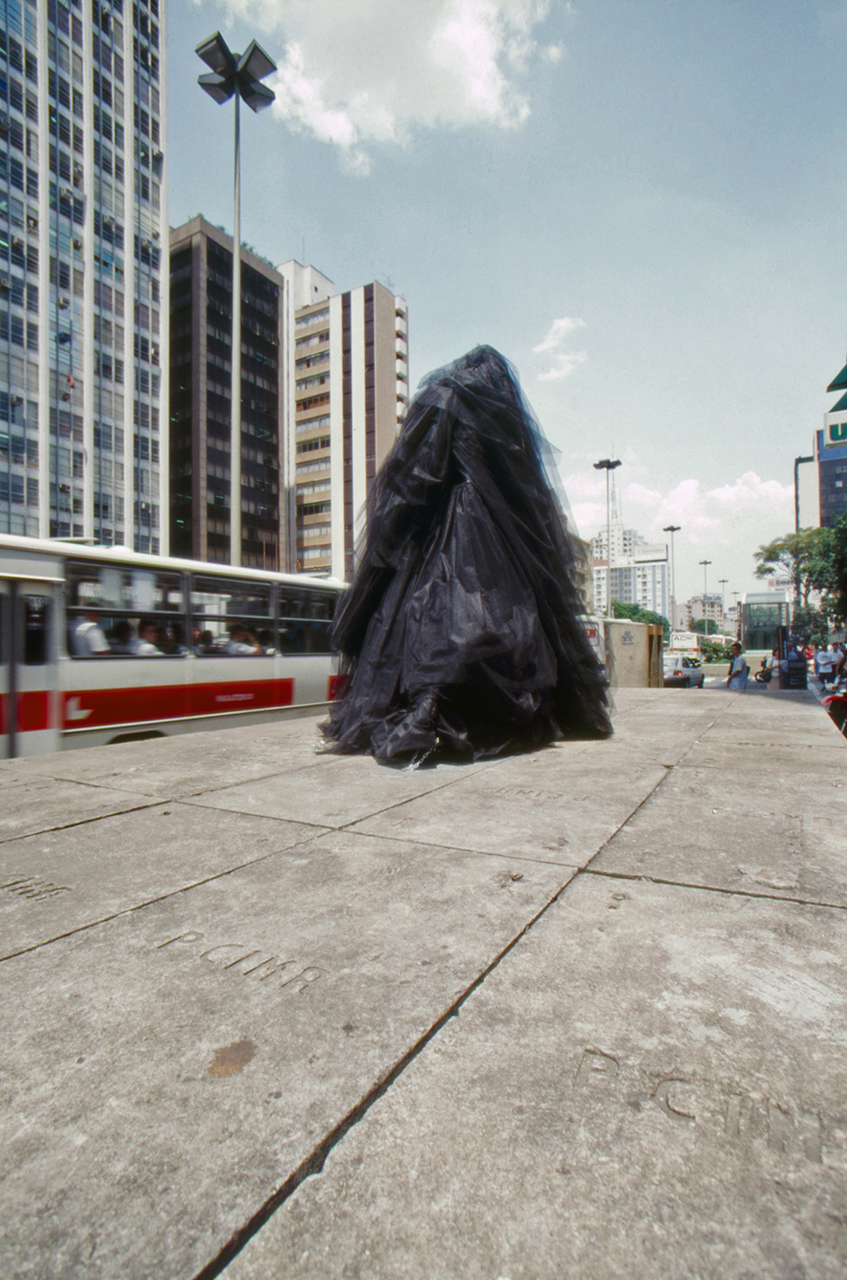
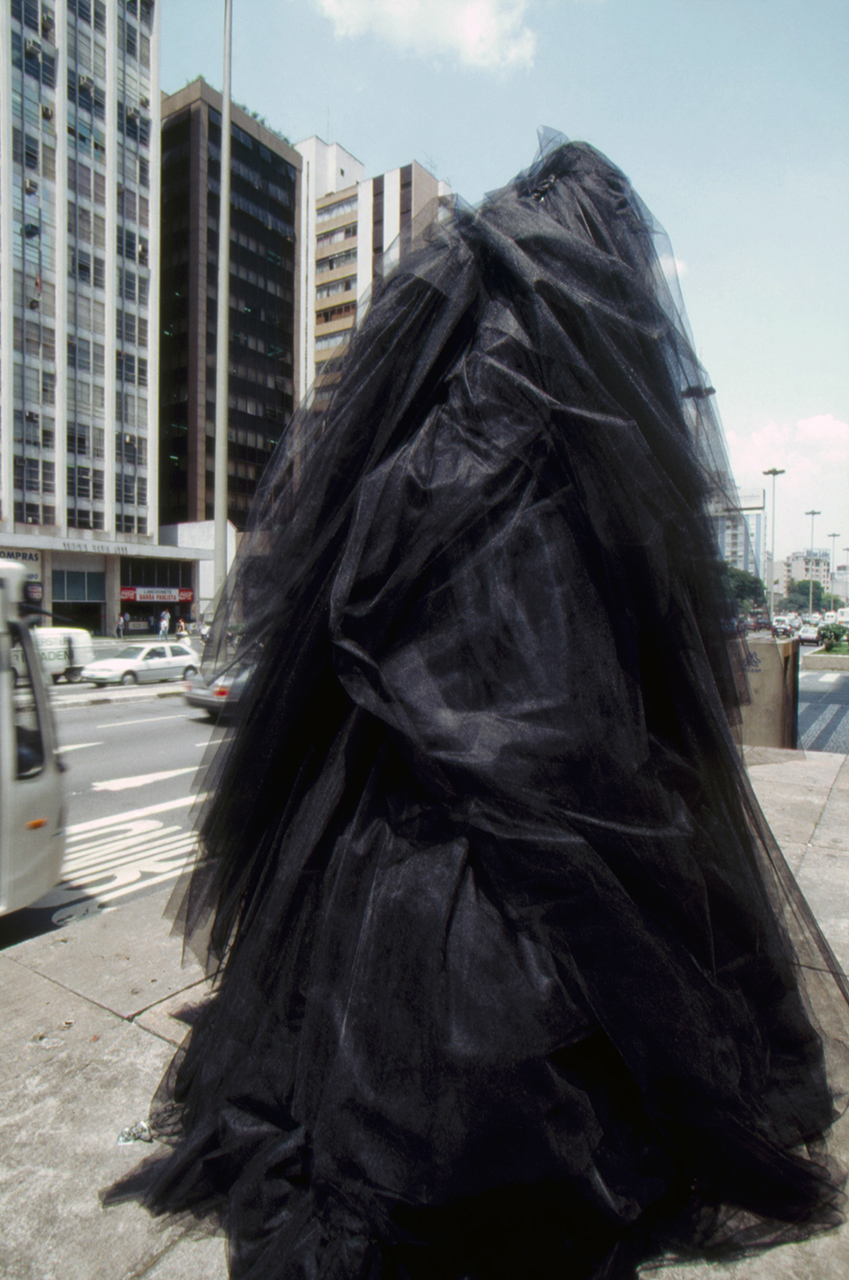
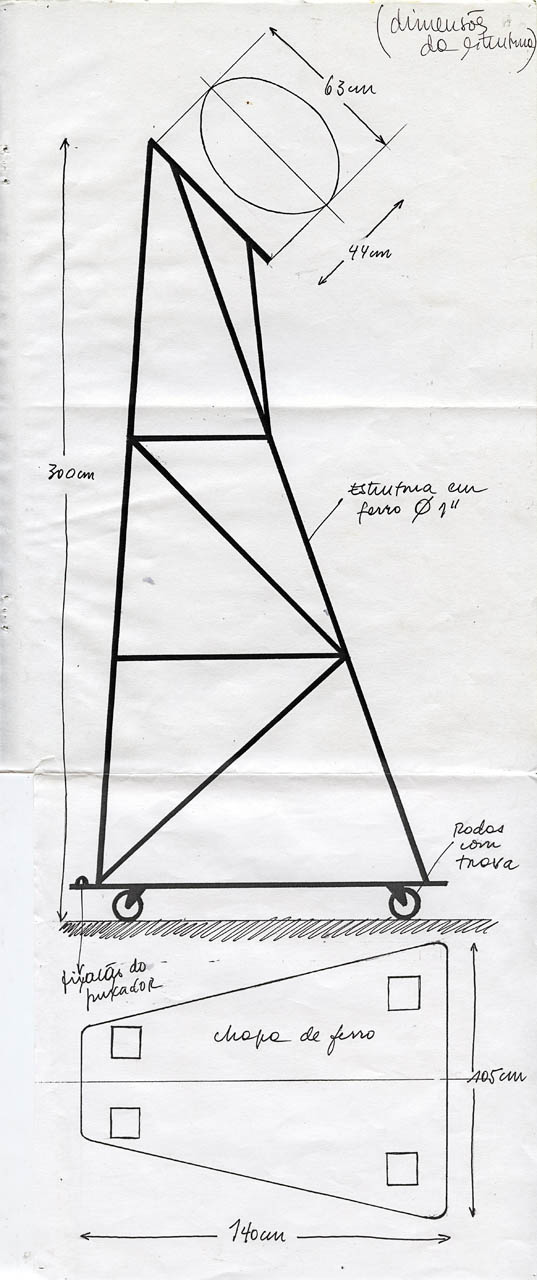
tule de nylon estrutura de ferro sobre rodas 3,30 × 2 × 2 m
nylon tulle iron structure on wheels 3.30 × 2 × 2 m
Existe uma relação desta NEGRA com A negra da Tarsila,* mas essa relação não foi armada antecipadamente. Elas não se aproximam pelos aspectos formais nem andam juntas no mesmo espaço. Apropriei‑me do nome para repensar meu trabalho em chave histórica. Um ready‑made para o título, uma espécie de duto temporal para o nosso modernismo. A NEGRA, de minha autoria, é um objeto‑montagem em ferro e tule de nylon preto, armado sobre rodas, que possibilitam seu deslocamento no asfalto ao longo da avenida. Penso-o também como objeto‑imagem, que se mistura ao movimento da rua, dos carros, dos sons e ruídos, das luzes dos edifícios, das lojas, dos anúncios. Contracena com a cidade mutante dos transeuntes – atravessar, voltear, passear, ir e vir, retornar. A figura d’A negra de Tarsila é território‑cor, casa-forma, corpo-pintura, na quase total extensão do quadro. Ela é a ala de frente, o samba-enredo, a porta‑bandeira, o mestre-sala, o destaque e o carro alegórico, tudo ao mesmo tempo, no desfile de um Brasil que se pretendia moderno, enquanto olhava para suas raízes. Mas enquanto na obra antológica de Tarsila a negra aparece como um corpo sem veste, só superfície, no meu trabalho a figura fantasmática negra é um corpo vazio, com sua vestimenta de tule. [CG]
* Tarsila do Amaral, A negra, 1923. Coleção Museu de Arte Contemporânea da Universidade de São Paulo.
There is a relationship between this BLACK WOMAN and Tarsila’s*A negra, but this relationship was not set up in advance. They are not similar in formal aspects, nor do they go together in the same space. I took the name to rethink my work as a historical key. A ready-made for the title, a kind of temporal duct for our modernism. THE BLACK WOMAN of my doing is an object-montage in iron and black nylon tulle, mounted on wheels that allow its movement on the asphalt along the avenue. I also think of it as object-image which mixes with the movement of the street, the cars, the sounds and noises, the lights of the buildings, the shops, the advertisements. It plays opposite the mutant city of passersby – crossing, turning, walking, coming and going, returning. The figure of Tarsila’s A negra is territory‑color, house-shape, body‑painting, in almost the entire painting. She is at the front of the carnival parade, the samba‑storyline, the flag-bearer, the master of ceremonies, the highlight and the allegorical float, all at the same time, in the parade of a Brazil that thought itself modern, while also looking at its roots. But while in Tarsila’s anthological work, the black woman appears as a body without clothing and with only a surface, in my work the black phantom woman is an empty body with its tulle clothing. [CG]
* Tarsila do Amaral, A negra (Black Woman), 1923. Collection of the Museu de Arte Contemporânea da Universidade de São Paulo.


 Carmela Gross
Você precisa fazer login para comentar.