Luiz Renato Martins
Translated by Eduardo Chaves
Publish in the book Carmela Gross: Carimbos. São Paulo: Instituto de Arte Contemporânea, 2023.
[português]
Expanded Links
What is the aim and the interest of an artist’s archive? Generally, it is subsidiary or dependent on the interest in the work to which it is connected as a document. The exhibition that presents the lending of the archives of the CARIMBOS [STAMPS] series by Carmela Gross to the Institute of Contemporary Art, on display from February 4th to May 6th, 2023, alters or inverts this current stratification.
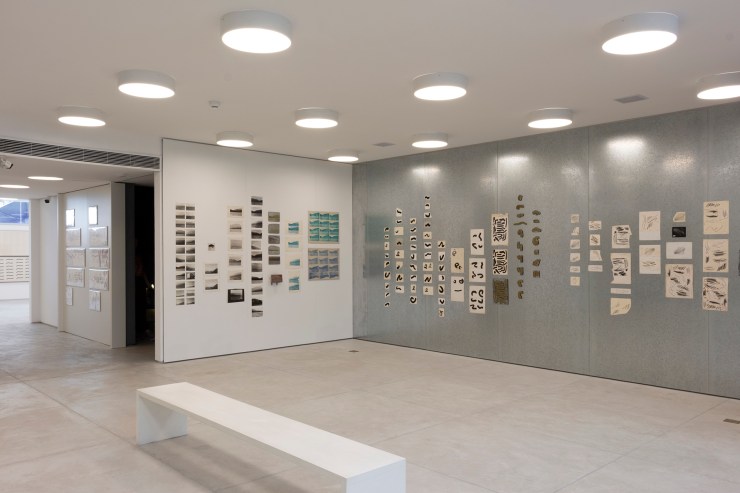
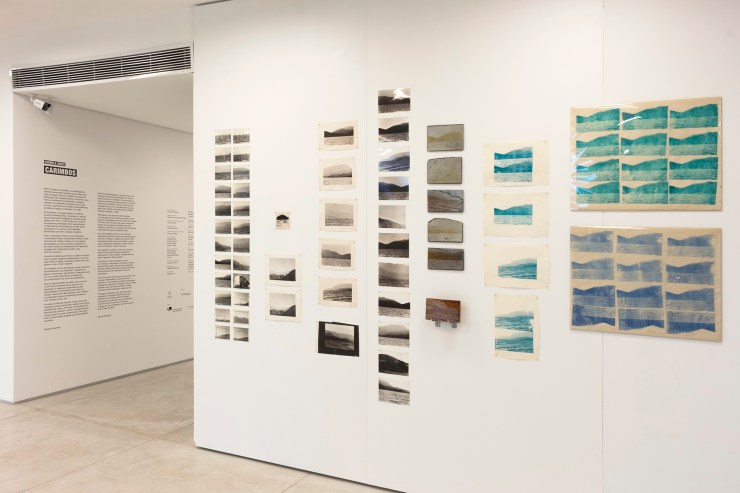
In fact, with the presentation of archival materials containing preparatory elements of the working process, the current exhibition allows for the revisitation and an expanded or extended reinterpretation of the content and meaning of the STAMPS series exhibition that took place in 1978 at Mônica Filgueiras and Raquel Arnaud’s Cabinet of Graphic Arts. In this case, it is not a refusal or essential alteration of the meaning of what was displayed in 1978, but rather – through the aggregated materials – of considering new layers of meaning. The original circle of meaning is thus resized. In this way, historical connections that eluded observers at the time now emerge and allow for the re-discussion of the work and its process in new and expanded terms.
In effect – judging by the journalistic material from 1978 (reports, interviews, and reviews) that constitutes part of the artist’s archive now presented – the observers’ commentaries at the time were then focused exclusively on the incidence and impact of the work in the art field, according to the critical priorities then established, either by the conceptual art trend or by its variant that would later be disseminated as the Institutional Critique current. According to the main line of both trends, artworks and artists were concerned only with art and nothing else, or, at most, only with the symbolic connections and scenic ties implied in the action.

From this perspective, in the 1978 exhibition, the paper plates resulting from the STAMPS series basically comprised the analytical decomposition, reduction, and automation of the expressive quantum of artworks’ segments from relevant authors in art history; in this case, obtained from disseminating books (in the circumstances, of Picasso, Matisse, Pollock, and Dubuffet) then available. Series of stamps – through the repetition of the ordered manual act on the plate, like in a layout, in lines and columns – reproduced the “cells” obtained by the processes alluded to above, thus accentuating and completing the emptying of value and meaning already triggered, such as in a laboratory crucible, by the aforementioned analytical and reductive operations.
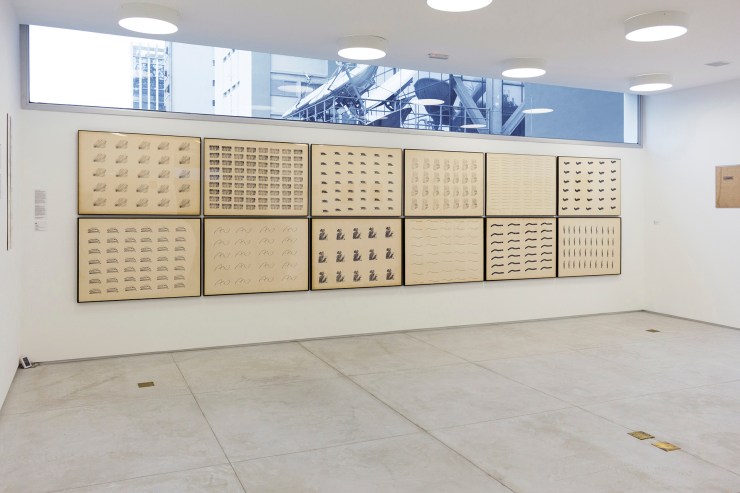
However, the counter-auratic critical process, inherent in the operations that engendered the works of the 1978 exhibition, now gained other ingredients, a new tone and hence, unless I am mistaken, greater symbolic and historical amplitude. How and in what terms? In fact, to integrate the current exhibition, Carmela Gross presented on an equal footing, alongside the results exhibited in 1978 (the stamped plates and sheets of paper), also other material elements and archived documents from the working process. The new set includes scraps of paper and other leftovers, assorted doodles, photos, and fragments of different experiences, besides items strictly related to the making of the stamps (rubberized surfaces, metal clichés, and wooden supports). These were built after the operations described above and used for manual printing of the series of stains, lines, scribbles, and brushstrokes displayed in 1978.

In short, the current combination emphasised the genetic component of criticism of the virtuoso and unique authorial gesture, already present in 1978, and it did so by intensifying exposure and attention to the working process, objectivating it in various ways and forms. If the focus on the inherent quality and specific nature of the results obtained (with the stamps) is thus restricted, suspended, or put on pause in favor of the work processes and related experiences – which are on equal footing – what else, in this movement, comes to the fore? What weaves one fragment to another, emerges and appears as a connecting element between one and another, that enables, lastly, the montage and architecture of the new whole now in focus?
Historical Reflection: Act 1
Moving beyond the exclusive domain of art, historical reflection, in its way of cutting out, encompassing, and connecting, is in itself a technique and an art form – just like architecture and montage in cinema; the art and the technique, in short, of drawing and building connections and spaces, even interconnecting presences to absences. Thus, in the specific domain of aesthetics, historical reflection correlates spatially procedures and surfaces, signs, and surroundings, as well as distinct historical temporalities. In this sense, the thinker and literary critic Roberto Schwarz coined the notion of objective form.[1] What does this kind of critical architecture and mode of totalisation obtain and suggest?
Concrete Art: Economy and Values
From the outset, a comparison or confrontation imposes itself over the horizon of sensibility and the criteria of concrete art, whose paradigm has exerted a lot of influence since the formation of the group Ruptura [Rupture] (1952) and throughout the movement’s entire duration in the 1950s and after. Despite the advent of new trends – such as the Nova Figuração [New Figuration](1965), the group Rex (1966, active in São Paulo), the Nova Objetividade Brasileira [Brazilian New Objectivity] (1967) etc. – its ethical and aesthetic legacy was still very much present during the STAMPS’ period of completion. These negate and overcome (dialectically) method and discipline, criteria and values, in short, the field and horizon of concrete art. The confrontation between the two productive modes favours the reciprocal clarification of each one.
What did the productive experience of concrete art consist of? Essentially, it entailed a rigorously planned conception that was to be unfolded with a basis on precision; that is, it aimed at a programmed and prepared execution against the occurrence of errors. In this way, for the sake of the ideals of planning and execution – embodied in the concretists’ cult of “good form” – the precept of summarily discarding failures ruled in concrete art.
Work as the Negative of Form
Now, it is precisely at this point of the STAMPSthat another plot – disconnected from the premise of “good form” – emerges and invites the current exhibition’s visitor to measure the steps taken while moving, without making any distinction between the form’s success and failure, among the elements collected from the working process.
If one stamping cannot be said to be more successful than another, what emerges between one stamp and another? Here again, historical reflection comes to prevent perplexity and aphasia by observing other plots, both related to the artist’s successive works and other contextual elements.
In this sense, it is possible to note that here themes and signs related to concrete traits of workers, who are often mentioned or evoked in other works by Carmela Gross (including allusions to the manual, oral, or bodily activity of anonymous workers, whether African, Indigenous, or immigrant, for example) are not seen here.[2] However, signs of the act of living labour,or of the living process of labour stand out, here linked to actions – beyond stamping, writing, scribbling, cutting, and photographing – undertaken by the artist herself engaged in a temporality inherent to her making, on several fronts.
They are, in fact, the materials, indexes and signs characteristic of the artist’s living work, which come to be – yes and no (in a dialectic way) – made visible, so the visitor can access the STAMPS’ backstage world; i. e., what remained invisible or out of the scene: the repeated exhalation, the delay, the lapse, the gap, the slip, the lack, in short, the surplus and the shortness, the tempos that occur between one stamping and another – elements that, after all, (for so many in a hurry) remain unnoticed, just like the spaces that surround the letters on the paper.
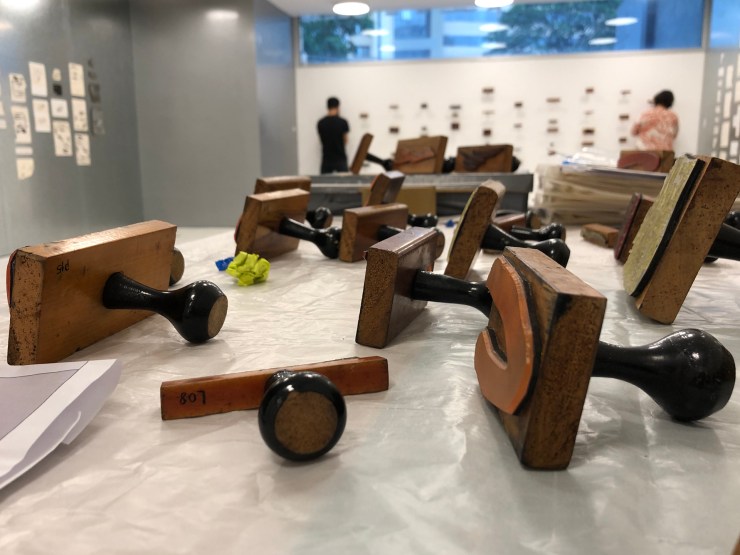
Living-labour: one’s time, the psychometabolic sensation, the quivering of each worker – is no less real, even when labour is subjected, wherever it may be, to the disciplinary regime of wage and alienation. In short, labour is perceived in varied and distinct forms. Thus, in contrast to its reception under an abstract and social form, as a commodity, labour appears inversely as time ceded and a living moment, from the point of view of who performs it.
Finally, returning to set the question regarding the STAMPS, despite the title of the series calling attention to the instrument and the result of the stamps, the unexpected and uncontrolled emergence of occurrences of a unique and singular content (or potentially with an epiphanic meaning) does not truly take place in the uniform consequence or as the result itself of each repeated stamping, but occurs, in fact, within the inherent temporality of the passage from one stamping to another; that is, embodied in the gesture that prepares itself and attacks the target (in this case, onto the paper) – seemingly mechanical and repetitive, yet always specific and unique, according to the subjective temporality of the worker.
Historical Reflection: Act 2
1977 and 1978, the years of conception and making of the STAMPS series, were simultaneously the awakening moment of the first strikes[3] in the country, after the long repressive wave that followed the enactment of AI-5 by the dictatorship (Dec. 13th, 1968).[4] The artist-practitioner – adept in conceiving the work as an act of critical friction or, regarding her sphere of action, as a dialectical reinvention and a negative response to the unequal order of the city – found herself, meanwhile, far from the strikes and without time to attend any of the meetings and assemblies that were taking place then in the yards and squares in the cities of the industrial hub. Would it be possible that, even so, she may have noticed even from afar and by default, something of herself and for herself in the resurging workers’ movement in Brazil?
Indeed, in light of such contemporaneity, it becomes possible to cogitate and ask whether the negativity inherent in the STAMPS series can be conceived as a mass strike (properly understood as each productive gesture of the artist) against fetishism in art and the related authorial whims? Specific negativity, one should note, translated into the massive multiplicity of productive gestures that are equivalent and which add up to, and consequently come to provoke, the suspension or denial of value judgments regarding the form or result (either successful or unsuccessful, according to other criteria, which do not fit here or become expendable).
Counter-Totemic Maneuver
Besides a fact, it is well-known that both the signature, as well as the authorial procedures of renowned names, trumpeted by the international art system (museums, publishers, etc.), foster the fetishism of form and authorship in art circuits.[5] Such totems, so to speak, have a mesmerizing effect mainly on peripheral and dependent cultures. They contribute to the petrification of the status quo and equally consolidate, in the domain of the arts, the directive to disregard one’s context and reality in favor of examples consecrated in hegemonic centers.
From a strategic or broader perspective, how can we understand what is at stake in the course of this counter-systemic maneuver? There are no elements to assume that the operations of the STAMPS series imply a programmatic refusal (e.g., supposedly in the name of nationalism or authenticity) of the “advanced artistic forms” derived from issues specific to “hegemonic cultures.” However, we can hypothesize, on the other hand, a punctual, limited, and preliminary measure, based on a scale of urgencies and priorities. What meaning or purpose would instead occur here?
If we trace the STAMPS series back to the specificity of its negativity, as previously outlined or identified, in a form analogous to a mass strike, it can be deduced – from the targeted and exposed materials – that such negation stands critically against the production of singular and illustrious authorial forms thus with a priori exchange value. In what sense? So that – hypothetically – in another historical-productive stage, artistic production can emerge, in fact, and rightly so, from the contradictions of its concrete situation. It will come thus formed for critical use in its own context, which it intends to renew.
Hence possibly stemming from this critical-constructive movement in a formative process, one can observe the effective convergence with the spontaneous mass strikes that erupted in 1977-1978. From the STAMPS’ critical standpoint, as happened with the workers’ strike movement, a new organization could then be formed, alive, and built in the struggle.
Strike as Enlightenment
After all, the speculative parallel between art and strike should not surprise. Rosa Luxemburg (1871-1919), who understood both the latter’s matter as well as the historical dialectic, asserted that the mass strike is not an appendage or instrument, an additional means to reinforce the effect of the proletarian struggle, but rather and first of all a formative and organizational act, the apex of a process of enlightenment: “It is rather the mode of movement of the proletarian mass, the form of manifestation of the proletarian struggle (…)”[6] (that is, to be understood here – in line with the proposed parallel between art and strike – as precisely the form of expression of each productive gesture, and of critical struggle, revived with each stamping, in this case).
The fact is that the STAMPS series 45 years ago and, yet again, the reconstructed montage (now on display), both carry out, like a roll of the dice, the reconstruction, exhibition, and revelation, the aesthetic objectivation, in short – of the practical sphere and of the mental-existential order – of a breath taken and passing between one gesture and another during the living labour, albeit segmented and repetitive, of the factory world, that prevailed in 1978 in the ABC region of São Paulo.
Objectivation and Totalisation
If this is the case, we are dealing here with much more than an anti-auratic critique (of art’s production and circulation circuits) – as understood at the time in the conceptualist and anti-institutional readings of the 1978 exhibition. In fact, today, with support from the new elements now included – and consequently with the renewed attention to the working modes – one can observe an effective process of meaning apprehension taking place. It is a process of a realistic nature, in the steps of the movement outlined in 1967 by the Brazilian New Objectivity. Objectivation, which in this case handles the inherently unpredictable and dangerous tenor of living-labour (a content, moreover, that Capital seeks to eliminate through the planned recourse to the machines’ form of constancy and predictability).
One last observation: the new plot distinguished as to the STAMPS series, when perceived as a way of totalizing the historical process, can be extended to the process of formation, organizational construction, and critical enlightenment of the workers’ movement at the time, understood as a parallel and additional element, of synergy or collective consolidation of the creative energy then at stake in the context, as we have seen. At the same time, the new plot, perceived as a way of totalisation, can also be extended to the temporal course of the history of Carmela Gross’s work. Thus, the STAMPS series, one can notice, anticipates – in the manner of a filmic negative – in many aspects (operations and nexus), the BOCA DO INFERNO [MOUTH OF HELL] series (2020),[7] presented at the São Paulo Biennal (2021).
In this way, the gaps, between one stamping and another, resonate and multiply, in an expanded and negative way, in the black lagoons or lacunas of MOUTH OF HELL, which serve as an epic-critical counterpoint to the State genocide process then in progress; a counterpoint also acknowledged, through other procedures, by the contemporary CABEÇAS [HEADS] (2021) series, exhibited at the Vermelho [Red] gallery as a moving testimony and tragic diagnosis of the programmed large-scale devastation then current in the country, subjected to the ultraright’s rule.
**
** Many thanks for the questions and sharp revisions (in Portuguese) of Gustavo Motta and Regina Araki.
Luiz Renato Martins is the executive editor of Cadernos do Movimento Operário [The Notebook of the Workers’ Movement](S. Paulo, Sundermann/ WMF Martins Fontes); published The Long Roots of Formalism in Brazil (Chicago, Haymarket, 2019) and Roda Gigante, with Carmela Gross (S. Paulo, Circuito/ WMF Martins Fontes, 2021).
Eduardo Chaves is a lecturer in the Department of English at the University of Massachusetts, Boston. He has also translated Fabio Akcelrud Durão, “From Text to Work” (FORMA 1, no. 2, 2020).
[1] Schwarz called, in 1979, objective form the operative aesthetic form that links the historical social and the aesthetic domain. Later, in 1991, he defined it as a form endowed with “practical-historical substance” and, in 1997, he called it the “social nerve of artistic form.” See, respectively, R. SCHWARZ, “Pressupostos, salvo engano, de ‘Dialética da Malandragem’” [1979], in Que Horas São?, São Paulo, Companhia das Letras, 1989, pp. 129-55 [English trans.: “Objective Form: Reflections on the dialectic of roguery” in Two Girls and Other Essays, edited by Francis Mulhern, translated by John Gledson, London, Verso, 2012]. For the 1991 citation, see “Adequação Nacional e Originalidade Crítica” [1991], in Seqüências Brasileiras/ Ensaios, São Paulo, Companhia das Letras, 1999, p. 31, see also p. 247 [English trans.: “National Adequation and Critical Originality in the work of Antonio Candido,” translated by Nicholas Brown, in Cambridge Review of International Affairs, 34:2, 2021, pp. 207-227]. For the 1997 citation, see Duas Meninas, São Paulo, Companhia das Letras, 1997, p. 62 [English trans.: Two Girls, op. cit., p. 111].
[2] See, among others, the untitled installation in the collective exhibit Gente de Fibra (São Paulo, Sesc Pompeia, 1990), or yet: BURACOS (1994), FACAS (1994), A NEGRA (1997), CARNE (2006), SUL (2006), SE VENDE (2008), REAL PEOPLE/ ARE DANGEROUS (2008), ESCADAS (2012), MIGRANTES (2014), TUPI (2014), DESTERRO (2017), RODA GIGANTE (2019) etc.
[3] After student strikes and demonstrations in the city of S. Paulo during 1977, in early 1978 the first open strikes of metalworkers broke out in the ABC region (Santo André, São Bernardo and São Caetano), the group of interconnected cities that then constituted the main industrial pole of the state of São Paulo, and of the country. The various irruptions, initially spontaneous in 1978, gained scale in this region on March 14 of the following year – the eve of General Figueiredo’s inauguration – when a mass strike broke out, with strong support (about 200,000 metallurgists), covering workers from the major automakers in the automotive sector (Volks, Ford, Mercedes, Scania, etc.) and from auto parts factories.
[4] Protests were prohibited after Dec. 13, 1968, by Institutional Act Number Five, also called AI-5, followed by arrests, torture, censorship, and purges, for years.
[5] It does not matter if the renowned artists (Picasso etc.), involved in the analytical procedures of the STAMPS series, are or are not, for themselves, responsible for the process of fetishization of the forms in question. Here, in such cases, the merit is not under discussion, but only the form of reception.
[6] [italics from the original ] Rosa LuXemburg, “Greve de massa, partido e sindicatos” [1906] [‘The Mass Strike, the Political Party and the Trade Unions’, trans. by Nicholas Gray], in Rosa Luxemburgo: textos escolhidos vol. I (1899-1914), organized and revised by Isabel Loureiro, translated from the German by Stefan Fornos Klein, São Paulo, Ed. da UNESP, p. 299. I thank the recommendation of the reading to Isabel Loureiro [English trans.: Rosa Luxemburg, The Complete Works of Rosa Luxemburg/ Volume IV, Political Writings 2: On Revolution – 1906 – 1909, edited by Peter Hudis and Sandra Rein, translated by Jacob Blumenfeld, Nicholas Gray, Henry Holland, Zachary King, Manuela Kölke, and Joseph Muller, London – New York, Verso, 2022, p. 222].
[7] Created in 2019-2020, in Porto Alegre, on the presses of the Iberê Camargo Foundation and with the assistance of the engraver Eduardo Haesbaert.
 Carmela Gross
Você precisa fazer login para comentar.